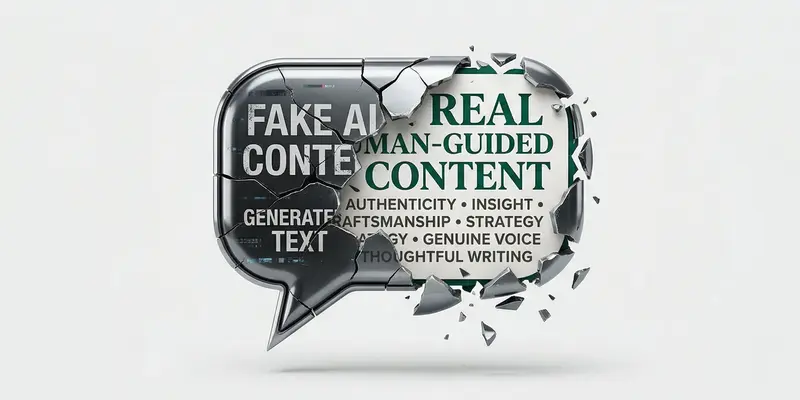
Why does so much AI content feel fake? And how do I fix it?
It’s the same problem every time.
You give the model a clear topic. It gives you clean writing. The language is correct. Everything looks “right.” Then you read it and it feels cold. No soul. No stance. No sign that a real person is behind it.
That’s the real issue.
AI defaults to safe language. Polite. Balanced. Generic. The result is content that fits everyone, connects with no one, and gets forgotten fast.
I don’t treat this as a writing problem. It’s a voice problem. An angle problem. A context problem. You can produce a technically “good” draft that still doesn’t represent your brand or convince your customer.
TL;DR
- It’s a voice problem, not a language problem.
- Start with a position, a structure, and real context.
- Humanize after the draft, not before.
Table of contents
Why it sounds fake
Usually for three obvious reasons:
1) No point of view
It explains, but it doesn’t say anything. No opinion. No stance. Just clean sentences.
2) The same structure every time
Same intro. Same rhythm. Same predictable flow. Even if readers can’t explain it, they feel it.
3) No real details
No market examples. No actual situations. Nothing that sounds like lived experience.
The system I use
1) Start with a position, not a title
If you don’t have a clear opinion, the model runs to generic language.
Instead of: “AI helps with content writing.”
Say something with weight:
“Speed is useless when the voice is wrong.”
2) I build the structure myself
The biggest mistake is letting the model decide the flow. Then you’re surprised the output is generic.
I define:
- The main idea
- The points that must be said
- The warnings
- The red flags
It helps me execute. The direction is mine.
3) I inject my own vocabulary
Everyone has a personal dictionary. Every brand does.
I lean on words like: Clear, practical, direct, execution, outcome, market, customer, ROI
And I avoid inflated words like: Revolutionary, seamless, game‑changing, redefining, radical
These words expose AI fast. And they sound like recycled marketing.
4) I force real context
If you don’t give it context, it writes for everyone.
But if you say:
- Write the example for a founder of a small services business in Saudi
- Use a case with a site, ads, and WhatsApp as the sales channel
Suddenly it sounds real.
5) I break the fake rhythm
AI loves balanced sentences. That rhythm kills humanity.
So I break it on purpose:
- A short line.
- A longer one.
- A single sentence on its own.
- Then a direct hit.
That change matters. A lot.
6) I edit for voice, not grammar
Most people edit like it’s a grammar exam.
I ask a simpler question: Would I actually say this out loud? If not, it goes. Even if it’s “perfect.”
The point isn’t correctness. The point is fit.
7) Humanize after the draft
The common mistake is asking the model to be: “Human, natural, smart, informal, professional, convincing…”
The output gets tense and performs.
I do it in two steps: Draft first, then humanize. Cut, reshape, break rhythm, add real voice.
The rule I follow
If the text works for anyone, it probably doesn’t work for you.
Real content needs:
- A stance
- An angle
- Details
- A voice
- A sense that a real person knows what they’re saying
Otherwise it’s just “clean.” But dead.
Common questions
How do I make AI writing feel natural?
Don’t start with “make it natural.” That’s a result, not an instruction. Start with a clear position, a solid structure, and real context. Then edit for voice.
Why does it sound robotic even when the info is correct?
Because correctness is not enough. Content that convinces needs a voice, a point of view, and details that signal real experience.
Can AI copy a brand voice?
Yes, but not from nothing. If you don’t define what you accept and what you reject, it defaults to generic writing that sounds like everyone else.